
The NFL Transcends (Today)
The Pillar of American Fandom

What We Share
What connects Americans? This is a variation of the more loaded question of “what is an American.” It sounds like a gotcha question—like when cable news asks what is a woman?
My answer is Taylor Swift and the NFL. Sounds trivial.
The question of what connects Americans is an essential one because it shines a spotlight on how fragmented America has become. I can’t help it if the culture and political wars have created an environment where asking what Americans share or have in common creates controversy. Astute observers should realize that the groups responsible for creating polarization are the ones that don’t want to talk about cultural fragmentation.
We live in a multicultural society and era—with few shared demographic traits or beliefs. The political divide continues to widen. At the moment, we don’t even have shared values about things like free speech or free market economics.
So what do we share?
The NFL and Taylor Swift.
These are the two things that an American needs to know about to be a part of the cultural conversation in 2026. Do you think Mahomes will surpass Brady? Can you believe Taylor got married in MSG?
The NFL is our shared sport, and Taylor is our shared music. No offense to Taylor, but the NFL is more interesting from a cultural perspective. Pop stars come and go. Other pop culture contenders like Minecraft or Love Island also fall short—they don’t appeal to the mass market. The NFL is enduring, dominant, and for everyone.
Saying that the NFL is the dominant American sports league is like proclaiming that water is wet. The Super Bowl is an unofficial holiday celebrating American pop culture. It is the day of the most-viewed sport, the most-listened-to musical show, the day of the most gambling, the most expensive advertising, and maybe the second biggest day of eating. But the NFL isn’t a one-day spectacle. The league is part of the sports calendar almost year-round—the season, the playoffs, free agency, the college draft, the launch of the latest edition of the Madden video game. By revenue and viewership, the NFL is the biggest thing in American sports. Fantasy football connects friends and families. NFL teams connect cities. NFL quarterbacks might be the most famous people in many cities—name someone from Cincinnati, Jacksonville, or Buffalo not named Burrow, Lawrence, or Allen.
The Data
Today’s article is about demonstrating the NFL’s status in American culture. I’ve got data on fandom from my annual fandom survey that illuminates the NFL’s unique ability to connect Americans. The data includes fandom rates for the NFL, the NBA, MLB, and the Olympics. These sports were chosen because they represent four of the most popular sports entities. The fandom rates for these four sports entities are 46.7% for the NFL, 36.5% for the NBA, 33.5% for MLB, and 32.3% for the Olympics. The first point supporting the NFL’s special position is its 10 point plus lead over the other major sports properties. It’s not a surprising point.
Where the NFL’s cultural dominance story, its unique role as a connector, becomes compelling is when we drill down into subsegments and compare fandom across segments who would seem to have little in common.
The first table shows fandom rates for the four sports for different demographic cuts. With rare exceptions, the NFL is the leading league by fandom rate across each pair of divergent segments. The NFL is the number one league for Conservatives and Liberals. It is the number one league for the faithful and for the non-religious. Men and women? Yep, both prefer the NFL. I could have extended the table to include breakdowns by income or education. It doesn’t matter—the NFL always wins. Almost.
Two places where the NFL doesn’t lead, but it is very close. The first is in Gen Z. In Gen Z, the NBA slightly leads the NFL with a fandom rate of 38.9% versus the NFL’s 37.1%. The NFL leads in all the other generational cohorts. The Gen Z story is a big one—one that deserves its own analysis. So it’s something I’ll defer to another day. The second place is race (not shown in the table). Black respondents have an NBA fandom rate of 47.7% versus 46.3% for the NFL—the rates for the broader category of non-white also favor the NBA, 45.0% versus 43.6%. Even in these two spots, NFL fandom exceeds a third of the population and is within 2 points of the NBA.
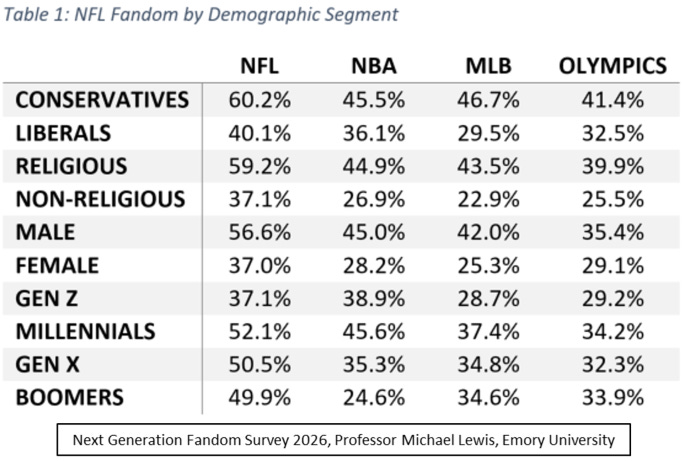
The demographic cuts illuminate the NFL’s centrality. We are a politicized nation but conservatives and liberals in Chicago can take a break from arguing politics to share conversation about Caleb Williams and the Bears.
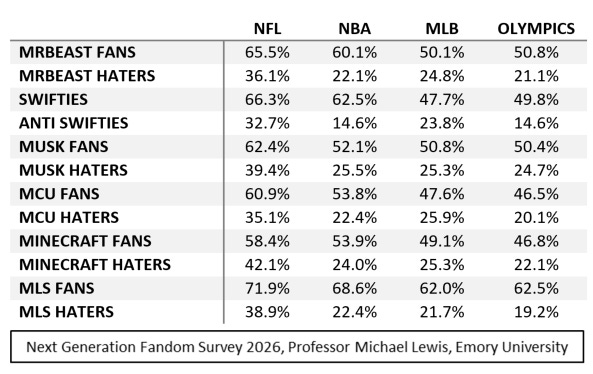
The second table goes beyond demographics to measures of cultural interests. To do this I have created segments based on fandom or hatred for celebrities and entertainment properties—MrBeast, Taylor Swift, Elon Musk, the Marvel Cinematic Universe, and Minecraft. I even threw in a sports segment, MLS fandom. The list isn’t particularly systematic—it was created with an eye towards variety.
It is a very different approach to segmentation, as people are divided based on cultural interests. In many ways it’s a better approach. Segmenting based on other fandoms captures differences in preferences. Demographics correlate with cultural interests, but fandom segments capture those preferences more directly.
But the story is pretty much unchanged. Swifties’ and Anti-Swifties’ favorite sport is the NFL. Same result for MrBeast fans and haters, Musk fans and haters, MCU fans and haters, etc. It’s close in some places—less than 6-point gaps between the NFL and the NBA for MrBeast Fans, Swifties, Minecraft Fans, and MLS Fans. It’s not close for the Hater segments.
The other insight that pops off the page is the comparison between fandom rates across fan and hater segments. The Fan segments’ NFL fandom rates often approach double the Hater segments’. This is true for the other sports properties as well. This reveals something essential about the nature of fandom. Fandom is best viewed as an individual psychological trait—people who are fans of one thing are often fans of many things. Fandom is an indicator of someone’s propensity for cultural engagement.
The Importance of the NFL
On a day-to-day basis, popular culture is what connects Americans. The common soundtrack of America is the NFL, the MCU, Taylor Swift, and whatever is trending on Netflix. It’s what everyone else knows, so being a part of the group requires knowing it as well. In an era where politics is contentious and our narratives about America are often contradictory, pop culture may be the strongest connector that remains—other than shopping at Walmart and Amazon?
In our modern America, the NFL largely stands alone. Maybe more Americans are fans of the movies or television, but these are categories composed of many shows. The NFL is one of the very few specific things that gets half the country—Coca-Cola is the other one I know of. The NFL might just be our primary cultural pillar. If it’s not, it’s up there with Thanksgiving turkey, Santa Claus, and Coca-Cola.
There was an old Chevy commercial in the 1970s that included the phrase, “baseball, hot dogs, apple pie, and Chevrolet.” It was about connecting a car brand to American culture. Updated for 2026, the campaign might use football, tacos, apple pie, and F-150s—cynically, the America of 2026 would develop the ad with partners, and it would be the “NFL, Taco Bell, Coca-Cola, Apple, and F-150s.”
The comparison to an old Chevy ad highlights that culture keeps moving. Chevy was a cornerstone of American car culture half a century ago, but barely registers now (outside of trucks, and the Corvette). The NFL is dominant today, but there is a crack or two. The NFL slightly trails the NBA with our youngest cohorts and non-white audiences. The NFL is our most shared cultural product, but the future will be contested.
The Survey
This is another entry in my reporting on the 2026 Next Generation Fandom Survey. I wrote an earlier post (CLICK here) that describes the survey and provides a link to the full sports fandom report. Just as an FYI, the survey covers fandom across a wide range of cultural sectors, so the sports report is just the first of several. This is a one-man operation, so I work on whatever is top of mind, but the second report should be out next month. That one will likely focus on movies and video games.