
Future Fandom: Interlude - Caitlin Clark's Prospects

Two Theories of Stardom and Caitlin Clark
Caitlin Clark has had one of the most distinctive years in sports history. Clark burst into public consciousness during the women’s 2023 NCAA tourney. Her combination of trash-talking (including dismissive gestures) and long-range shooting made her a featured star on ESPN. To sports fans, with little interest in women’s basketball, she was interesting and fun. The 2023-24 college season only magnified Clark’s stardom. Her season began with a record setting outdoor game in the football stadium and ended with her as an all-time scoring leader, albeit one that never won a championship.
Along the way, Clark began to transcend being just a great college athlete to become a genuine celebrity. Clark has become the face of the WNBA, appeared on Saturday Night Live, and signed a $28 million deal with Nike. Through the first few weeks of the WNBA season, Clark has been the focal point for the league as the “Caitlin Clark Effect” has been credited with the league’s shift towards chartered flights, sold-out stadiums, record prices, and strong TV viewership.
The question is whether this is real or hype. This question is better phrased in terms of degree. What we are witnessing is real, as Clark is a unique player, but there is also significant hype as she has been massively promoted. How much of this is a permanent shift, and how much is a temporary shift in fandom? There is merit to the argument that Clark is good for the WNBA, but there is also merit to the idea that Clark is receiving excessive (and jealousy-inducing) attention.
As a starting point, the economics literature has two “classic” theories of Superstars. In these theories, superstars are performers who earn extraordinary salaries. More generally, this means that superstars are extremely popular compared to even performers will only slightly lower capabilities. The popularity can be reflected by salaries or other measure of popularity (followers, downloads, sales, etc.). In the first theory, superstars earn extreme compensation because being even a little bit better attracts almost the entire market. The second-best singer or actor is not quite as good, so almost the entire audience chooses the best performer. The “best” performer, therefore, enjoys massive rewards, and the almost but not quite as good performer enjoys only a moderate reward. This theory is fairly compatible with sports stardom as there are significant returns to championships.
In the second theory, stardom is a social phenomenon. Stars attract the majority of the market because they are stars. In this version, being a fan has a vital social component. Taylor Swift may not be the “best” singer, but being a Taylor Swift fan comes with advantages like always being able to find another Taylor Swift fan. Consuming popular movies, music, and shows enables fans to be part of the cultural conversation. This second theory, the social theory, is less relevant to sports because sports tend to have an objective reality. There are no objective criteria for the best singer or actor, but the best athletes defeat their opponents.
Clearly, in most settings, both performance quality and social aspects play a role in fandom. It's probably skewed towards merit in sports and social in most entertainment categories.
This is also a useful lens for thinking about the long-term prospects of the Caitlin Clark “Phenomenon” or “Effect.”
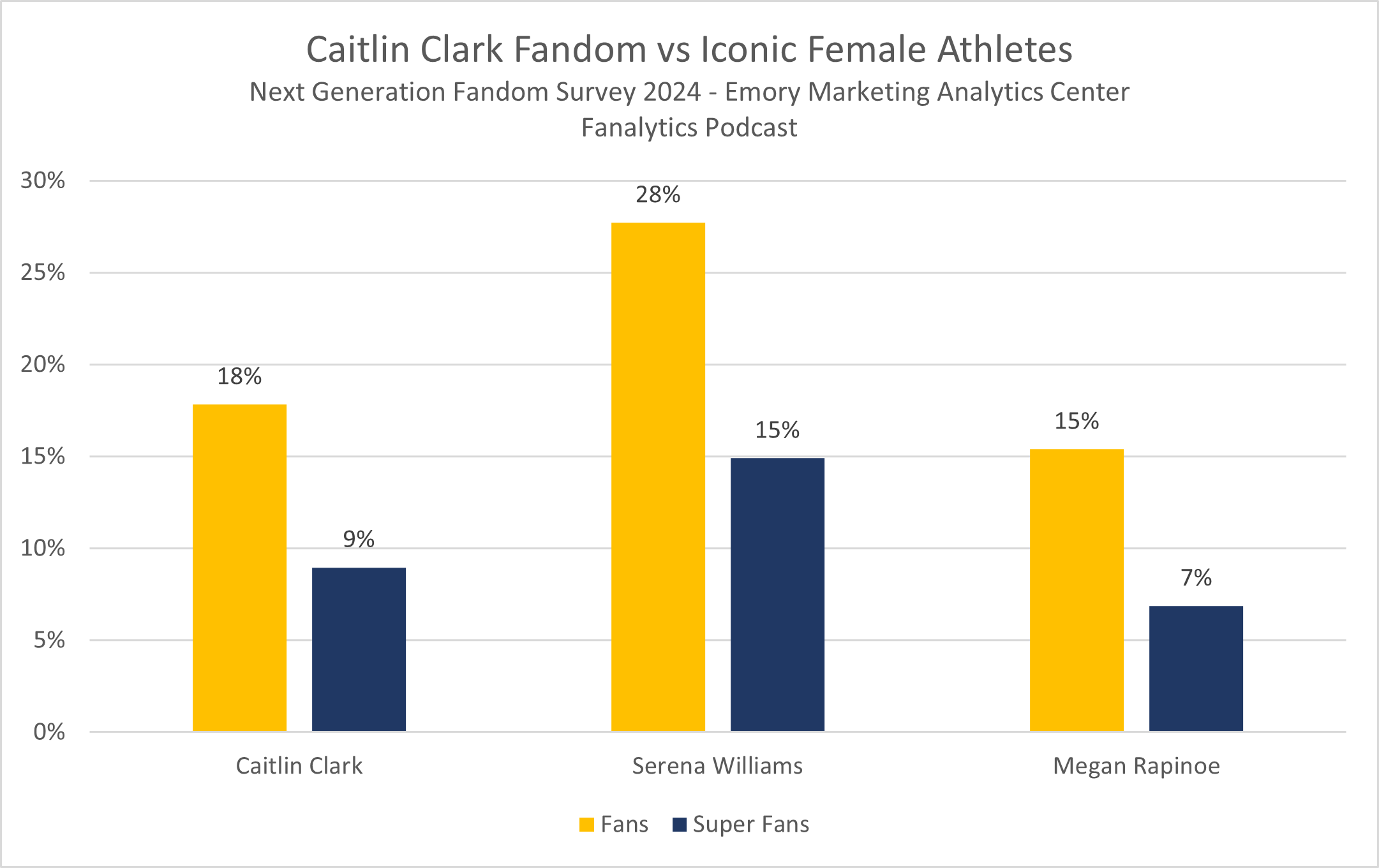
Clark’s stardom was built on objective quality, with some amusing personality elements (e.g., not guarding Raven Johnson at the three-point line). But there is also a social element, as she has become the biggest name in women’s basketball. As a college senior breaking records, Clark was the perfect star. Talent and compelling, well-known narratives. The Figure below shows Caitlin Clark's fandom rates compared to Serena Williams and Megan Rapinoe. The data is from March, so even while the NCAA tourney was progressing Clark had fandom numbers comparable to a couple of female athletic GOATs.
The question is how this will translate to the WNBA. The conventional wisdom seems to be that Caitlin Clark has some uniquely compelling set of attributes that will attract significant numbers of new fans who will then become WNBA fans. The theory is that Caitlin Clark will take the WNBA to a new level.
How realistic is this? Clark has lots of support as the media and brand sponsors are eagerly embracing women’s sports. The question is whether Clark can perform at the level necessary to maintain the Caitlin Clark “Hype”? At the moment, the Clark effect is more curiosity and less fan devotion. Clark isn’t filling arenas for the same reason that Michael, LeBron, and Kobe did. It’s not even the same as Messi coming to MLS.
It was real in the NCAA, but it’s all based on promise and projection now.
Does Caitlin Clark have the talent to maintain the “Caitlin Clark” brand at the next level? This is a daunting task because she needs to be a generational star to fulfill the hype.
Clark’s Basketball Prospects
What do the numbers tell us about Clark’s likelihood of becoming a generational talent? Analytics is a challenge in the WNBA because there is a relative lack of data. Rather than building a model, reviewing a few data points is more useful. Going back a decade, we have six women who have led the NCAA in scoring who are not named Caitlin Clark.
· The 2023 scoring leader Maddie Seigrist of Villanova averaged 29.2 ppg in 2023 and scored 3.5 ppg for the Dallas Wings.
· The 2020 scoring leader (24.8 ppg), Stella Johnson of Rider, played in 15 WNBA games, averaging 3.9 points per game in 2020 and 2021.
· The 2019 and 2018 scoring leader Megan Gustafson of Iowa averaged 27.8 ppg as a senior but only 2.9 as a rookie for the Dallas Wings. She has played for four teams in 6 WNBA seasons.
· The 2017 scoring leader, Kelsey Plum of Washington, scored 31.7 as a senior before scoring 8.5 ppg for San Antonio. Plum is the star of the leading scorers, though, as she has averaged over 18 ppg for the Las Vegas Aces in 2022 and 2023.
· The 2016 scoring leader (29.0 ppg), Jasmine Nwajei of Wagner, did not play in the WNBA.
· The 2015 scoring leader, Kelsey Mitchell of Ohio State, averaged 24.9 ppg as a senior and a respectable 12.7 as a rookie for the Indiana Fever.
· The 2014 leader, Jerica Coley, played for FIU, averaging 29.5 points her senior year, but she did not play in the WNBA.
Clark averaged 31.6 ppg as an Iowa senior in 2024 and has scored at a rate of 17.2 ppg as a rookie (through 8 games) for the Indiana Fever. This ranks her as the 13th leading scorer in the league (number 4 in assists). Unfortunately, her team is 1 and 7 through 8 games.
The data is, as always, inconclusive. A quick observation is that college scoring has little correlation with professional success. There are a couple of issues worth noting. First, Clark led the collegiate level in scoring three times. Her level of sustained dominance suggests that she may be a little bit “different” than the other women on the list. Second, the fact that a University of Iowa player was the scoring leader in half of the last ten seasons suggests that Clark played in a scorer-friendly system.
A full analysis of Clark’s prospects is far beyond the scope of this piece, but a couple of aspects are worth mentioning: one positive and one question. First, the positive: Clark is more than a scorer as she led women’s college basketball with 8.9 assists per game. Her ball skills also complement her scoring, as she can create space and shots. Also, her early season WNBA assist numbers suggest that she is broadly productive, not just a scorer. Second, a question: Clark does not exhibit physical superiority as a rookie. Projecting players to be dominant at the next level is easier when the player has exceptional physical traits. Magic Johnson was a 6’ 9” point guard, Larry Bird had unprecedented shooting and passing skills for a 6’ 9” player, Michael Jordan was possibly the greatest athlete in the world, and Lebron James was a unique physical specimen. Clark may be just an above-average WNBA athlete. The lack of data complicates this analysis, but Clark seems to have great quickness in terms of change of directions but lacks strength and leaping). Is she more Trae Young than Michael Jordan? The women’s game is different, but the lack of next-level athleticism leaves significant questions about Clark’s future dominance.
Caitlin Clark’s Marketing Prospects
Caitlin Clark’s stardom started from a place of merit. Her shooting prowess and her on-court personality made her both the best player in college and a compelling personality. But Clark’s stardom has not been allowed to evolve naturally. Immediately following Clark’s breakthrough, we saw media efforts to create narratives such as her “rivalry” with Angel Reese. Clark’s stardom has also been accelerated by social forces invested in promoting female sports and by marketers looking for a new celebrity. Clark’s stardom is transitioning from being performance-based to being social-based and Clark has become a genuine celebrity. The issue is that Clark’s level of fandom is unstainable unless she becomes the (not a) dominant WNBA player. This is possible but far from certain. There is also an issue of time. Clark’s Indiana Fever team is unlikely to make the WNBA playoffs. If the 2024 WNBA season ends with the Fever as bottom dwellers and Clark as a third-team or honorable mention all-WNBA player, will the hype fade? Will fans wait multiple seasons for Clark to arrive?
My guess is that Clark doesn’t ascend high enough or quickly enough in the WNBA hierarchy to maintain the hype. But it is a great story to watch, and she has all the marketing and media support in the world. She may or may not be a generational basketball talent, but she is the center of a generational marketing effort.